
Newaygo Court Records After Arrest
Newaygo County court records after a jail arrest usually start in the 78th District Court. The district court covers Newaygo and Lake Counties and handles arraignments, bail setting and acceptance, misdemeanors punishable by up to one year, trials, sentencing, and preliminary examinations in felony matters. Magistrates may set bail, accept bond, take certain pleas, and issue arrest or search warrants authorized by the prosecutor or municipal attorney.
The court record is different from the jail record. A jail record reflects custody and booking. Court records show the filed charge path after the prosecutor acts. For custody and booking questions, use Newaygo County jail inmate records. For booking photos, use Newaygo County jail mugshots. For the court case itself, use the official court search and docket sources.
Find Newaygo Court Records After Arrest
The county Circuit Court page links users to official public case content through MiCOURT. Use the general MiCOURT Case Search, the Newaygo Circuit Court direct case link, or the county's public docket display when the case has reached that court. The portal is best for filed charges and court events, not for confirming whether a person is still in jail.
- Open MiCOURT or the Newaygo court link from the county Circuit Court page.
- Search by the defendant's name or case information when known.
- Open the public case result and review the court, case number, charge entries, hearing dates, and disposition lines.
- Compare the court charge list with the jail or VINE custody status, because custody can change while the case remains open.
The official MiCOURT portal is the main statewide trial-court case search channel for Newaygo County criminal court records.
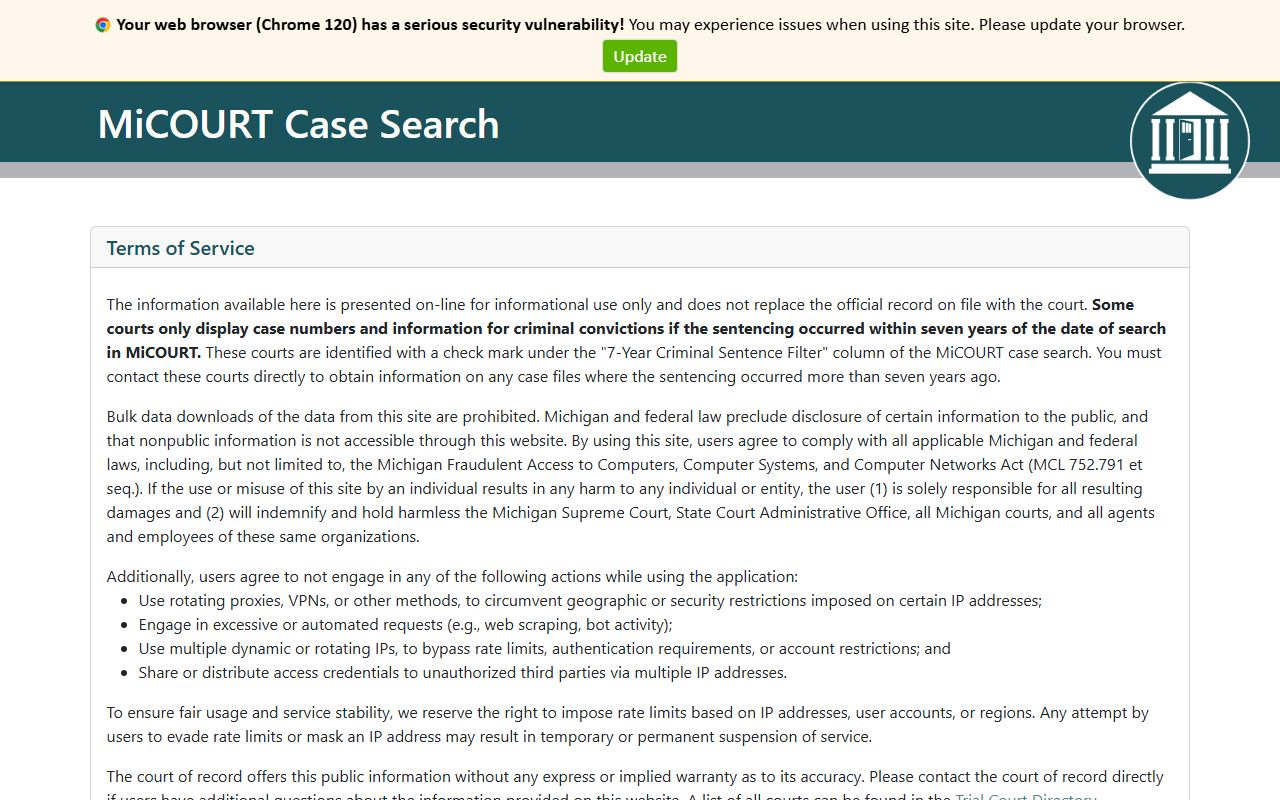
MiCOURT is a court-record tool, so it should be paired with the jail or VINE when the question is present custody.
Charges After Newaygo County Arrest
The Newaygo County Prosecuting Attorney is the charging authority for state-law and county-ordinance criminal cases. Research identifies Rachel Robinson as the county prosecutor. The office represents the people of Michigan in misdemeanor and felony prosecutions and appears in District and Circuit Court. After a jail arrest, the prosecutor may authorize, decline, amend, reduce, or add charges.
| Document | What It Does | Newaygo County Context |
|---|---|---|
| Complaint | Starts many criminal cases and states the alleged offense | Often tied to early District Court proceedings |
| Information | Formal felony charging document after bindover | Used when a felony moves toward Circuit Court |
| Indictment | Charging document returned by a grand jury | Less common locally than complaint or information |
A booking charge is an arrest or holding basis. A court charge is the prosecutor's filed accusation. The two may differ because prosecutors review police reports, witness facts, evidence, and legal elements before filing or amending charges.
Newaygo Charge Status Records
Charge status changes as the case moves. A Newaygo County court record may show pending charges at arraignment, amendments after review, reductions from felony to misdemeanor, dismissals, pleas, or sentencing entries. The public case record should be read by date because an older entry may no longer describe the current posture of the case.
| Status | Plain Meaning | Why It Matters |
|---|---|---|
| Pending | The charge is active and not finally resolved | Court dates and bond conditions may still apply |
| Amended | The charge was changed by the prosecutor or court process | The final charge may differ from the booking entry |
| Dismissed | The charge was dropped or ended without conviction | Other charges in the same case may still remain |
| Bound over | A felony moved from District Court toward Circuit Court | The case may appear in a different court record view |
| Disposed | The charge has a final court result | The outcome may be plea, verdict, dismissal, or sentencing |
Bond After Newaygo County Arrest
Newaygo County's official bonding page says a bond is posted to obtain release and assure the person's presence in court. It instructs people to call the jail to obtain the proper bond amount required by the court, which means a generic online bond schedule should not be substituted for the current court order. Cash bonds can be posted at the appropriate court during normal business hours, while online bond or bail money can be posted through eXpressAccount at any time.
| Bond Issue | Local Detail |
|---|---|
| Cash bond | Posted at the appropriate court during normal business hours |
| Online bond payment | County links eXpressAccount for 24-hour online bond or bail money posting |
| Credit or debit card | Mastercard and Visa accepted online, with a nominal fee noted by the county |
| Bond company | Several companies are court-approved; contact the court or jail for the list |
| Hold or detainer | Federal, another-court, parole, probation, medical, classification, or immigration issues can block release |
MCL 765.6 says bail cannot be excessive and directs courts to consider appearance and public safety. Bond does not override every hold.
Warrants Before Court Records
No official public Newaygo County active-warrant search was found on the Sheriff's Office pages during research. Warrant questions should be routed through official court, jail, or records channels. The 78th District Court page says magistrates may issue arrest and search warrants authorized by the prosecutor or municipal attorney. The prosecutor's criminal procedure material says a felony or misdemeanor case may start from a ticket, citation, or arrest warrant.
Michigan law also matters. MCL 764.3 addresses bench warrants after failure to appear and includes a 48-hour rebuttable presumption for a first failure to appear, with exceptions. A person who believes a warrant exists should contact the court, counsel, or the jail rather than relying on an unofficial search result.
Charges Versus Convictions
Court records after a Newaygo County jail arrest can show charges long before they show any conviction. A charge is an accusation filed in court. A conviction is a final legal result after a plea or verdict. Public records can show both, but they do not mean the same thing.
| Point | Charge | Conviction |
|---|---|---|
| Stage | Filed accusation after arrest or review | Final result after plea or verdict |
| Proof level | Based on charging standards and probable cause | Based on plea or proof beyond a reasonable doubt |
| Can change? | May be amended, reduced, added, or dismissed | May later be appealed or set aside if eligible |
| Search source | MiCOURT and court records | MiCOURT, MSP ICHAT, and sometimes OTIS after sentencing |
Sealed Expunged Newaygo Records
Michigan's set-aside law, MCL 780.621, governs eligibility to set aside certain convictions. A set-aside is not the same as a private website removal request, and it is not the same as a jail booking-fee refund. Court and criminal-history visibility depends on the exact case result, timing, eligibility, and agency records involved.
| Issue | Sealed / Restricted | Set Aside / Expunged |
|---|---|---|
| Public view | Public access may be limited by rule or order | Eligible convictions may be set aside under Michigan law |
| Agency access | Some official access may remain | Law-enforcement and court access may still exist in limited ways |
| Who decides | Court, statute, or record custodian | Court process under Michigan set-aside law |
| What to verify | Case status and public access limits | Eligibility, order entry, and affected agencies |
Newaygo Criminal History Checks
Michigan State Police ICHAT is a statewide public criminal-history channel, not a Newaygo County jail roster and not a warrant search. MSP says ICHAT includes public felonies and serious misdemeanors punishable by more than 93 days from all Michigan counties. It does not include suppressed records, warrant information, federal records, tribal records, traffic records, juvenile records, local misdemeanors, or out-of-state history.
Important: Do not use casual court or custody searches for FCRA-covered employment, housing, credit, or insurance decisions.